
Three Elopements, Three Different Reasons To Get Married | A Vancity Officiant Ceremony Story


After officiating hundreds of elopements over the years, there are certain days that stay with us long after the marriage licence has been filed and the photographs have been delivered. This is one of them.
Every now and then, I find myself exploring ideas that fall a little outside a traditional wedding setting. Not because a ceremony needs to be bigger, more elaborate, or more unique, but because certain places seem to carry a feeling that naturally lends itself to a wedding ceremony.
Years ago, when the sunflower festival was still located in Chilliwack, before its move to Harrison Hot Springs, one of those ideas became a pop-up elopement event. I've always had a soft spot for sunflowers. Like many people, I was drawn to what they represent. There is something hopeful about standing in a field filled with thousands of bright yellow blooms, all turning toward the light. It felt like the kind of place where people might want to pause for a moment and acknowledge an important chapter in their lives.
So we worked with the festival team to create a small pop-up elopement experience within the sunflower fields. The idea was simple. Couples who were already planning an intimate wedding could exchange vows surrounded by acres of sunflowers during one of the most beautiful weeks of the season.
At the time, I assumed the flowers would be what I remembered most.
Years later, I can barely remember which section of the field we used, where the chairs were placed, or even which direction the ceremonies faced. What I remember are the three families who stood among them.
Over the course of a single afternoon, we officiated three elopements. On paper, they looked remarkably similar. All three ceremonies took place in the same sunflower field. All three involved a relatively small number of guests. All three couples chose a simpler path to marriage than a traditional wedding. While all three ceremonies would typically be categorized as elopements, we've found that couples often use the term to mean very different things.
Yet as the afternoon unfolded, it became clear that each couple had arrived there for a completely different reason.
A Small Wedding Surrounded By Family

The first ceremony was probably the closest to what many people imagine when they hear the word "elopement."
The couple gathered approximately ten family members and invited them to witness their vows among the sunflowers. There was no elaborate production, no carefully choreographed timeline, and no attempt to recreate a traditional wedding on a smaller scale. Instead, the focus remained exactly where they wanted it to be: on the commitment they were making and the people they wanted beside them.
One of the assumptions people often make about elopements is that they are about leaving family behind. Yet throughout our years of officiating, we have often seen the opposite. For some couples, choosing a smaller ceremony is not about excluding loved ones. It is about creating more space for the people who matter most.
Watching this ceremony unfold, that was exactly what came to mind. The guest list may have been small, but the sense of support surrounding the couple felt anything but. Their ceremony was not about stepping away from family. It was about sharing the moment with the people who had helped shape their lives long before the wedding day arrived.
A Marriage Ceremony That Included A Child

The second ceremony revealed a very different story.
From a distance, it looked similar to the first. A couple stood together in front of family and friends, ready to exchange vows and begin the next chapter of their lives. Yet as the ceremony progressed, it became clear that this wedding was about more than the relationship between two people.
The couple already had a son, and what stayed with me was the way they included him in their vows. Rather than speaking only about their promises to one another, they also spoke about the family they had already created together. Their son was not simply attending the wedding. He was part of the reason the ceremony carried such significance in the first place.

One of my favourite photographs from that afternoon captured that moment perfectly. Not because it was dramatic or emotional in an obvious way, but because it reflected something many people overlook when they think about marriage. Marriage does not always mark the beginning of a family. Sometimes the family already exists, and the ceremony becomes an opportunity to acknowledge it. In many ways, the wedding was not creating a family that day. It was recognizing one.
An Indigenous Family Bringing Culture And Family Together
The third ceremony remains the one I remember most vividly.
Before the ceremony even began, it was clear that family would play an important role in what was about to take place. As guests gathered among the sunflowers, the procession began with the sound of a drum carried by the couple's son, something the family shared was an important part of their culture. The bride was accompanied by her grandfather, while their daughter walked alongside them as they made their way toward the ceremony space.
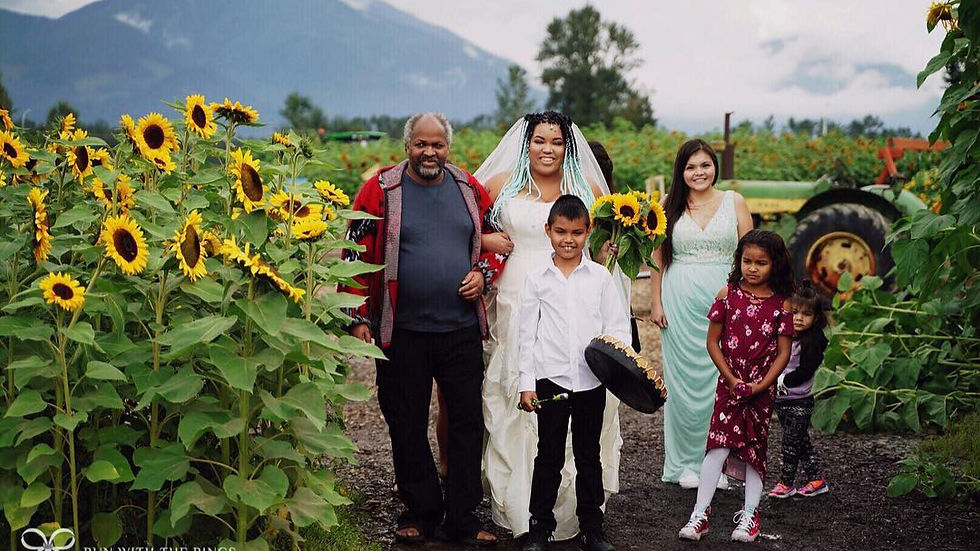
From the very beginning, every member of the family had a role within the ceremony. They were not simply attending the wedding. They were helping to shape it.
What stayed with me most happened during the vow exchange itself.
Rather than standing alone as a couple, the bride and groom stood together with their son and daughter, forming a circle as they exchanged their vows. It was a simple image, but years later it remains one of the clearest memories from that afternoon. Many people think of marriage vows as promises exchanged between two people. Standing in that sunflower field, it felt different. The children were not watching from the sidelines. They were already part of the story being acknowledged that day.

What made the ceremony memorable was not any single tradition on its own. It was the way marriage, family, and culture all existed together within the same moment. The drumming, the grandfather accompanying the bride, and the family circle during the vow exchange all reflected a marriage that was already connected to something larger than the couple themselves.
Many people associate elopements with simplicity, independence, or stepping away from tradition. Yet this ceremony reminded me that a smaller wedding does not necessarily mean leaving traditions behind. Sometimes it simply creates more space for them.
Even now, years later, I can still remember the sound of the drum carrying across the field as the family approached through rows of sunflowers. It wasn't the size of the wedding that made it memorable. It was the way family and culture were woven so naturally into the ceremony itself.
What Three Elopements Reminded Me About Marriage

Wedding professionals often describe elopements using practical terms. Smaller. Simpler. More intimate. While those descriptions are often accurate, they only tell part of the story.
What I witnessed that afternoon was not three versions of the same wedding. It was three different ways that marriage was being acknowledged.
For the first couple, the ceremony created space to celebrate with the people closest to them. For the second couple, the ceremony acknowledged a family that already existed. For the third family, the ceremony brought together marriage, family, and cultural traditions within the same experience.
All three ceremonies took place in the same sunflower field. All three would likely be categorized as elopements. Yet what each ceremony represented was entirely different.
Looking back, that is what stayed with me. It wasn't the flowers, the venue, or any particular detail from the event itself. What I remember are three families standing in the same field on the same afternoon, each arriving at marriage from a different place in life.
At the time, I thought I was creating a sunflower elopement experience. Years later, what I remember most has very little to do with sunflowers at all. I remember a couple who wanted to celebrate their marriage surrounded by the people closest to them. I remember parents who used their ceremony to acknowledge the family they had already built together. And I remember a family of four standing in a circle, surrounded by sunflowers, exchanging vows within a story that was already much larger than the wedding itself.
The flowers brought everyone to the same place, but each ceremony represented something entirely different. That afternoon reminded me that while elopements may look similar from the outside, they are often shaped by very different relationships, histories, and reasons for getting married.


